Did you ever wonder how we got here, and how sometimes tiny pieces of history make up, and have shaped our lives?
Or realised how every day, all of us are making history?
Join me, Sarah Dowd, in exploring what has happened in the everyday lives of people for the better, or at least the experiences that have just make us laugh and say…
This is… History. For F***’s Sake, the podcast that explores untold stories that make a difference.
When the world seemingly shut down for almost two years, what were we doing? We were creating art, making history and crying out of human contact. We were craving our culture.
I’m your host, Sarah Dowd, and I have worked on over 200 history, heritage and arts projects in the last 20 years across the world, everywhere from the Imperial War Museum in London to exploring how we put a fleet of ships in the sky, or bringing wrecks back from Honolulu.
I was recently diagnosed with ADHD which has brought a whole new layer of thinking about creativity and how we get people – ALL PEOPLE – really engaged with our shared history and culture.
Stories. Art. Film. Books. Ships. Music. Museums. People. Joy. Experiences. Humour. Humanity.
Because it’s all History, For F***’s Sake.
Find out more at historyffs.com
What does it take to transform a ‘crap town’ (I have never thought that!) into a cultural powerhouse? In this hopeful, hilarious, and sometimes hard-nosed episode of History for F**k’s Sake, host Sarah Dowd is joined by Simon Green, Hull’s longtime culture director, cultural regeneration strategist, and unrepentant champion of local pride to mark the 50th anniversary of the Northern Theatre Company and nearly a decade of the Maritime Hull vision.
Sarah and Simon explore the extraordinary, unexpected story of Hull’s transformation from a post industrial docks town to a beacon for arts-led renewal. Blending tales of trawlermen, council wrangles, and world-famous nude art installations, Simon offers a first-hand account of how working-class pride, maritime heritage, and a “just do it our way” spirit turned civic shame into national celebration. From the Arctic Corsair’s Cold War secrets to the blue-painted bravado of the Sea of Hull, this is an episode for anyone who believes that art, history, and community can remake a city and a future.
Here are the highlights:
- Simon’s journey from working-class roots to Hull’s top cultural job
- How Hull went from national punchline to City of Culture
- The unbreakable link between maritime history, civic pride, and the Hull identity
- Moving from “paternalistic” heritage to fearless co-creation with communities
- The real power of culture
- Gentrification versus grassroots – can renewal lift up everyone?
- The Arctic Corsair’s secret Cold War mission, Icelandic friendships, and shared loss
- Surprising outcomes like getting Hull on the BBC weather map!
- The good, the bad, and the “for f**k’s sake” moments
- Relentless storytelling, political reality checks, and why culture is not optional.
About Simon Green:
Simon Green recently retired as Managing Director of Hull City Council’s arms length Culture Company after a thirty-year career leading culture, heritage,leisure as a driver of regeneration in one of the UK’s most misunderstood cities. An advocate for people-first cultural programming, co-creation, and daringly ambitious events, Simon’s legacy includes transforming Hull’s image locally and nationally, championing the working-class and maritime stories at its heart, and mentoring the next generation of culture leaders.
Connect with Simon:
Linkedin http://linkedin.com/in/simon-green-65783712
X (Twitter): @srgreen13
About Sarah Dowd:
I’m Sarah Dowd – writer, speaker, heritage and arts consultant, producer, and all-around nerd – here to share the stories of our past that make us laugh, gasp, and mutter: It’s History… For F***k’s Sake.
For 25+ years I’ve created immersive, inclusive experiences that bring history alive, from rallying Second World War convoys through London to staging performances between Pearly Kings and Gen Z creatives. My work spans museums, cathedral crypts, pop-up theatres, global brands, and community projects across the UK and beyond.
As a Canadian living between the UK and France (with a late ADHD diagnosis that fuels my curiosity and creativity), I zigzag through culture, history, and big ideas, but never boring ones.
Every week on HistoryFFS, we explore how history echoes through today, from Drag Race to prefab tiny houses, with voices from musicians to mischief-makers.
Follow @HistoryFFS – because we’re all making history, one ridiculous, wonderful moment at a time.
Connect with Sarah:
Website:www.historyffs.com
LinkedIn:https://www.linkedin.com/in/sarahdowd/
Patreon: HistoryFFS
YouTube: @HistoryFFSPod
Instagram: @historyFFSPod
TikTok: @historyffspod
Produced by: winteraudio.co.uk
Follow the show for new episodes exploring the objects, people, and moments that shaped our world. If you want the story AND the sound of the past, this is essential listening.
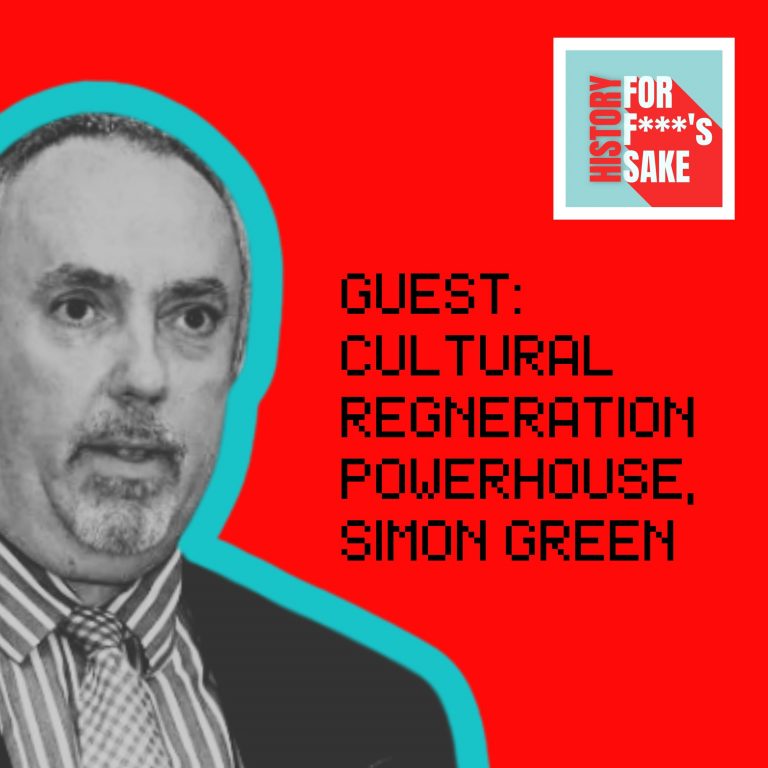
Until recently, Hull was more punchline than pride, a city lumped in with the UK’s ‘crap towns’, remembered mainly for its depleted fishing fleet and end-of-the-line geography. But as this week’s History for F**k’s Sake guest Simon Green explains, the city’s true story is nothing like the headlines suggest.
Working-class roots, fierce independence, and a real belief in the value of art, these are the threads Simon pulls together as he reflects on his three-decade journey from museum manager to Hull’s director of culture. He arrives in Hull, an “incomer” from York with a postman for a father and a carer for a mother. But it’s in Hull running its museums, leading its regeneration, and eventually steering the City of Culture bid where Simon finds his calling.
Hull’s revival was never about imposing something from above. “We moved from celebrating excellence to asking: what makes Hull the place it is for you?” Simon recalls. The old, paternalistic council gave way to genuine co-creation, listening to the stories that mattered most to local people. In a place shaped by sea-trade, trawlermen, and hardship, the city unearthed collective trauma, the triple trawler disaster, the scars of the Blitz and dared to celebrate them as sources of strength, not just sorrow.
This focus became real in events like the City of Culture 2017, when Hull’s pride was projected (literally) onto its buildings: the heartbreak of lost ships, the resilience after bombings, the shared memories lighting up city squares. Even the BBC weather team had to take notice, finally putting Hull on the national map.
But the episode isn’t just a feel-good story. Simon is candid about the tensions between regeneration and gentrification. Can new life come without rising rents, or is that simply the cost of progress? Hull’s answer: focus on opportunity for all. “If people are working and earning, that’s a price worth considering.” The city’s reborn marina, once derelict, now hums with life and jobs still unmistakably Hull.
Then there’s Hull’s delight in the gloriously unexpected: the Sea of Hull, where thousands of locals painted themselves blue and posed nude for art, capturing headlines and hearts. Or the Arctic Corsair, a trawler entwined in Cold War secrets, living proof of the hidden (and occasionally scandalous) stories behind every artifact.
Simon’s memories are full of moments both hilarious and moving, from the council member who wanted to clean priceless art with bread rolls, to the city-wide scramble after 2017’s cultural explosion. Through it all, one thing never changes: Hull’s refusal to stay quiet or small. As Simon says,“This place is just bloody-minded and resilient. It does things its own way.”
Hull’s story, like the best history, is proof that culture isn’t a luxury, it’s the heartbeat of a community and a lifeline for its future. Listen in for tales that are sometimes wild, often moving, and always honest: Hull, shouting back at the world, and finally being heard.