
Did you ever wonder how we got here, and how sometimes tiny pieces of history make up, and have shaped our lives?
Or realised how every day, all of us are making history?
Join me, Sarah Dowd, in exploring what has happened in the everyday lives of people for the better, or at least the experiences that have just make us laugh and say…
This is… History. For F***’s Sake, the podcast that explores untold stories that make a difference.
When the world seemingly shut down for almost two years, what were we doing? We were creating art, making history and crying out of human contact. We were craving our culture.
I’m your host, Sarah Dowd, and I have worked on over 200 history, heritage and arts projects in the last 20 years across the world, everywhere from the Imperial War Museum in London to exploring how we put a fleet of ships in the sky, or bringing wrecks back from Honolulu.
I was recently diagnosed with ADHD which has brought a whole new layer of thinking about creativity and how we get people – ALL PEOPLE – really engaged with our shared history and culture.
Stories. Art. Film. Books. Ships. Music. Museums. People. Joy. Experiences. Humour. Humanity.
Because it’s all History, For F***’s Sake.
Find out more at historyffs.com
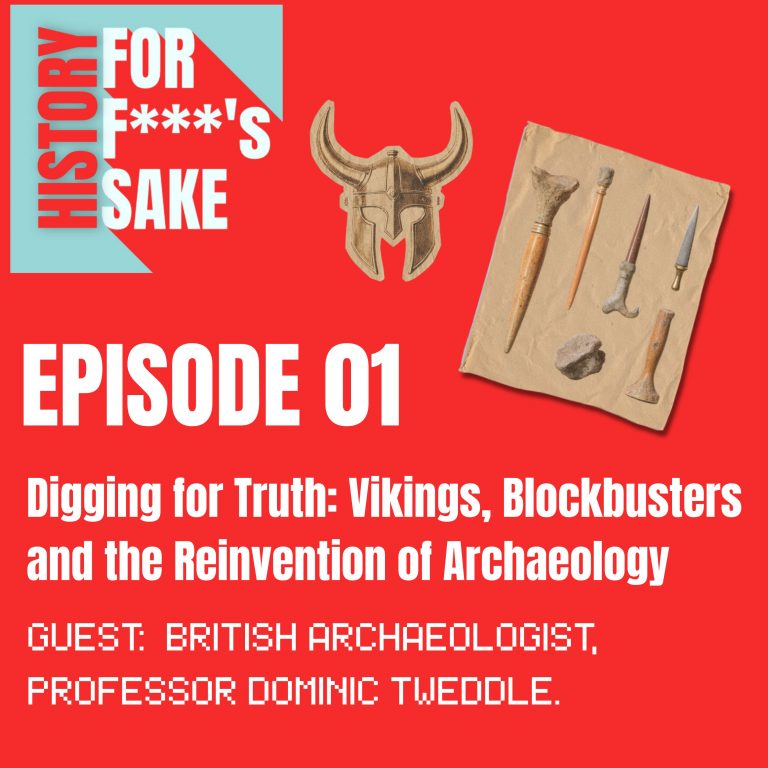
What connects the myth-busting boulder chases of Indiana Jones, revolutionary political ferment, and the mud-splattered rise of modern archaeology? In this episode of History for F**k’s Sake host Sarah Dowd sits down with Professor Dominic Tweddle, British archaeologist, museum leader, and expert in material culture for an honest, engaging journey through the origins, controversies, and future of digging up history.
From the Enlightenment’s curiosity-fuelled societies to the birth of systematic fieldwork, we explore how “holes in the ground” became battlegrounds for cultural meaning, power, and academic integrity. The episode traces archaeology’s evolution from treasure hunting and grave robbing, through the foundations of research and recording, into the revolutionary impact of pop culture (hello, Raiders of the Lost Ark) and immersive museum experiences like the Jorvik Viking Centre.
Whether you’re a history buff, a museum geek, or just want to know why a Viking street in York was a game-changer, this is essential listening for anyone curious about who gets to control the narrative of the past and how.
Here are the highlights:
00:00 Introduction: Pop culture’s impact on archaeology
02:02 Professor Dominic Tweddle’s journey
04:11 British Museum, hands-on with Sutton Hoo and medieval collections
05:15 The Coppergate Viking dig opens up a new era for public engagement
07:27 The genesis of Jorvik Viking Centre
09:45 Creating Jorvik Viking Centre: Reconstructing Viking York, immersive soundscapes, early museum innovation
15:55 Jorvik legacy, longevity, refurbishment, and financial impact
16:28 Raiders of the Lost Ark, its accuracy, and influence on archaeology
21:46 Antiquarianism, treasure hunting, and early excavation methods
22:31 The evolution of archaeological practice
34:02 Contemporary archaeology: What’s going right and wrong
About Professor Dominic Tweddle, BA, PhD, FSA, FSA Scot, MCIfA:
Dominic began his career as an archaeologist and historian at the British Museum before joining the York Archaeological Trust, where he was Assistant Director. He is a noted Anglo-Saxon and Viking specialist. In York, Dominic was a key member of the team that developed the ground-breaking Jorvik Viking Centre.
From there, he developed his own successful business, which designed, built, owned, and operated visitor attractions in the cultural heritage field across the globe. In 2008, Dominic sold his shares in the business.
He was appointed the first Director General of the new National Museum of the Royal Navy (NMRN) in 2009. In that role, he merged the four existing museums into a coherent whole and, through twelve mergers or acquisitions, brought eight historic warships, including HMS Victory, into the group. He built the turnover of the business from £6.5 million to £24 million a year and attracted £180 million in investment. Dominic retired in late 2023.
He is currently Chairman of the Maritime Archaeology Sea Trust, the leading UK charity working in the protection of underwater heritage, and is also writing a book on the Spanish Armada.
Dominic has written seven other books, five of them major academic works, and two children’s books. One, Growing Up in Viking Times, became a slightly unexpected bestseller.
Connect with Sarah:
Website:www.historyffs.com
LinkedIn:https://www.linkedin.com/in/sarahdowd/
https://www.linkedin.com/company/historyffs-pod/
Substack: @historyffs
YouTube: @HistoryFFSPod
Instagram: @historyFFSPod
TikTok: @historyffspod
Bluesky: @historyffs.bsky.social
Follow the show for new episodes exploring the objects, people, and moments that shaped our world. If you want the story AND the sound of the past, this is essential listening.
In this episode of History for F**’s Sake*, host Sarah Dowd welcomes Graham “Gaz” Brown; musician, conductor, vocal coach, and former army bandsman, for a frank, funny, and moving conversation about how music shapes memory, and how ordinary people end up living through extraordinary times. From growing up just outside Glasgow to performing in the Gulf War, Gaz’s story is about the power of sound to steady us, change us, and connect us, both to each other and to history itself.
From Glasgow to Kenya – via the Band Room
Gaz’s life in music began at home: his dad was a tenor, his mum played organ, and singing was simply part of family life. He played cornet and trumpet at school and showed promise early on, but his path to formal music training hit a dead end when he was told he’d need Grade 8 piano to get into college. “That was never going to happen,” he laughs.
A careers advisor offered another route: the British Army. Initially unsure, Gaz soon realised this meant playing music for a living and travelling the world to do it. His first flight took him not to a holiday destination but to Kenya, aged just 18, where he performed in military bands under the East African sun. What followed were years of training, discipline, and performance in places as varied as Belize, Edinburgh, and later, the Gulf.
War, Fear, and Music as Survival
The Gulf War marked a turning point, not only in Gaz’s life but in how he saw the role of music in extreme circumstances. “I remember sitting there thinking, I’m a trumpet player. What the hell am I doing here?” he recalls. But even in the middle of air raid sirens and desert heat, music didn’t leave him. A borrowed church organ became a place to write and reflect.
His mantra (formed in those high-pressure moments) has stayed with him: “If I can survive this, I can survive anything.” It’s not a dramatic flourish, just a quiet philosophy grounded in experience.
Life After the Army
Returning to civilian life wasn’t straightforward. Military structure doesn’t always translate to the creative world, and Gaz found himself navigating a series of jobs before setting up a recruitment business focused on helping veterans find their next step. But music remained his anchor. From ska bands and jazz nights to conducting choirs in Cambridge, his musical life kept evolving. Eventually, he released Time, an album inspired by his experiences in the forces, a personal act of storytelling through sound.
Queen, Theatre, and Soundtrack Moments
Alongside the heavier moments, the episode is filled with laughter, especially as Gaz and Sarah debate musicals, revisit memories of performing together, and geek out over Queen. For Gaz, Freddie Mercury’s voice is something close to sacred: “So clean, so precise, and so full of emotion.” The band’s influence becomes a recurring thread, culminating in a legendary Bohemian Rhapsody remix that had nightclub bouncers applauding.
Why Music Still Matters
At its heart, this episode is about music’s ability to carry memory. “It puts you back in that place like nothing else can,” says Gaz. Sarah agrees: “music isn’t just a reflection of history, it’s part of how we write it.”
Whether he’s teaching, composing, or simply sharing war stories with his old music teacher, Gaz is still finding ways to connect the past with the present, one note at a time.
Listen to the full episode of History for F**’s Sake for more on Gaz’s story, and how music continues to make, and make sense of, our most defining moments. [Link]