


Did you ever wonder how we got here, and how sometimes tiny pieces of history make up, and have shaped our lives?
Or realised how every day, all of us are making history?
Join me, Sarah Dowd, in exploring what has happened in the everyday lives of people for the better, or at least the experiences that have just make us laugh and say…
This is… History. For F***’s Sake, the podcast that explores untold stories that make a difference.
When the world seemingly shut down for almost two years, what were we doing? We were creating art, making history and crying out of human contact. We were craving our culture.
I’m your host, Sarah Dowd, and I have worked on over 200 history, heritage and arts projects in the last 20 years across the world, everywhere from the Imperial War Museum in London to exploring how we put a fleet of ships in the sky, or bringing wrecks back from Honolulu.
I was recently diagnosed with ADHD which has brought a whole new layer of thinking about creativity and how we get people – ALL PEOPLE – really engaged with our shared history and culture.
Stories. Art. Film. Books. Ships. Music. Museums. People. Joy. Experiences. Humour. Humanity.
Because it’s all History, For F***’s Sake.
Find out more at historyffs.com
What links a trumpet in Kenya, a Fringe tent in Edinburgh, and a military parade in New York? In this episode of History for F***’s Sake’ host Sarah Dowd is joined by Graham (Gaz) , musician, music director, vocal coach, and one-time army bandsman for a wide-ranging chat about the unexpected path that took him from the outskirts of Glasgow to stages and stadiums around the world.
From his earliest memories of family singalongs to playing his first paid gigs in uniform abroad, Gaz talks through the twists and turns of a life shaped by both discipline and creativity. There’s laughter, big opinions (especially about Queen), and a fair bit of swearing, as they compare notes on the best musicals ever written, the worst biopics ever made, and why music doesn’t just reflect history… it sometimes drives it.
Here are the highlights:
- How a teenage trumpet player from Glasgow found his calling in the army
- Surviving the Gulf War and the night he wore a gas mask for 11 hours
- How Gaz wrote an album called “Time” in a desert church with a borrowed keyboard
- The decision to leave the military and forge a life in music, sales, and self-employment
- Why Bohemian Rhapsody is a masterpiece and how it became the soundtrack to a theatre friendship
- How songs anchor us to history, emotions, and the most human parts of ourselves
- The surreal joy of playing trumpet in the New York Gulf War Victory Parade
- What Gaz would erase from history, the past he’d relive, and why he never confessed his love for ABBA (until now).
About Graham Brown
Graham joined the Army in 1987 as a musician, completing a one-year course at the Royal Military School of Music, Kneller Hall and serving as a medic in the first Gulf War. He left the Army in 1993 to pursue a career in sales and spent eight years in media sales working initially for the education specialist, Hobsons Publishing selling on print and electronic graduate and undergraduate titles. From there, he was headhunted to be Sales Manager of The Officer and RAF In-Flight magazines and was responsible for the concept and development of Quest magazine. Following the completion of an MA in Film Composition, he left Quest as Publishing Development Director to set up Forces Recruitment Services, the first commercial consultancy to assist ex-military candidates across all ranks and services in 2001.
Connect with Graham:
LinkedIn: https://www.linkedin.com/in/exmilitaryrecruitment/
About Sarah Dowd:
I’m Sarah Dowd – writer, speaker, heritage and arts consultant, producer, and all-around nerd – here to share the stories of our past that make us laugh, gasp, and mutter: It’s History… For F***k’s Sake.
For 25+ years I’ve created immersive, inclusive experiences that bring history alive, from rallying Second World War convoys through London to staging performances between Pearly Kings and Gen Z creatives. My work spans museums, cathedral crypts, pop-up theatres, global brands, and community projects across the UK and beyond.
As a Canadian living between the UK and France (with a late ADHD diagnosis that fuels my curiosity and creativity), I zigzag through culture, history, and big ideas, but never boring ones.
Every week on HistoryFFS, we explore how history echoes through today, from Drag Race to prefab tiny houses, with voices from musicians to mischief-makers.
Follow @HistoryFFS – because we’re all making history, one ridiculous, wonderful moment at a time.
Connect with Sarah:
Website:www.historyffs.com
LinkedIn:https://www.linkedin.com/in/sarahdowd/
Patreon: HistoryFFS
YouTube: @HistoryFFSPod
Instagram: @historyFFSPod
TikTok: @historyffspod
Follow the show for new episodes exploring the objects, people, and moments that shaped our world. If you want the story AND the sound of the past, this is essential listening.
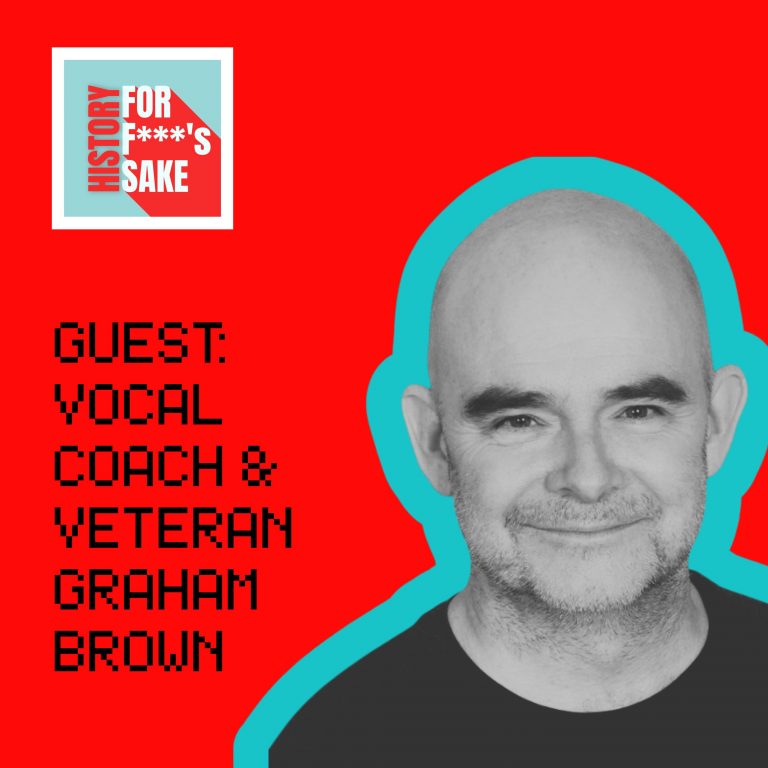
In this episode of History for F**’s Sake*, host Sarah Dowd welcomes Graham “Gaz” Brown; musician, conductor, vocal coach, and former army bandsman, for a frank, funny, and moving conversation about how music shapes memory, and how ordinary people end up living through extraordinary times. From growing up just outside Glasgow to performing in the Gulf War, Gaz’s story is about the power of sound to steady us, change us, and connect us, both to each other and to history itself.
From Glasgow to Kenya- via the Band Room
Gaz’s life in music began at home: his dad was a tenor, his mum played organ, and singing was simply part of family life. He played cornet and trumpet at school and showed promise early on, but his path to formal music training hit a dead end when he was told he’d need Grade 8 piano to get into college. “That was never going to happen,” he laughs.
A careers advisor offered another route: the British Army. Initially unsure, Gaz soon realised this meant playing music for a living and travelling the world to do it. His first flight took him not to a holiday destination but to Kenya, aged just 18, where he performed in military bands under the East African sun. What followed were years of training, discipline, and performance in places as varied as Belize, Edinburgh, and later, the Gulf.
War, Fear, and Music as Survival
The Gulf War marked a turning point, not only in Gaz’s life but in how he saw the role of music in extreme circumstances. “I remember sitting there thinking, I’m a trumpet player. What the hell am I doing here?” he recalls. But even in the middle of air raid sirens and desert heat, music didn’t leave him. A borrowed church organ became a place to write and reflect.
His mantra (formed in those high-pressure moments) has stayed with him: “If I can survive this, I can survive anything.” It’s not a dramatic flourish, just a quiet philosophy grounded in experience.
Life After the Army
Returning to civilian life wasn’t straightforward. Military structure doesn’t always translate to the creative world, and Gaz found himself navigating a series of jobs before setting up a recruitment business focused on helping veterans find their next step. But music remained his anchor. From ska bands and jazz nights to conducting choirs in Cambridge, his musical life kept evolving. Eventually, he released Time, an album inspired by his experiences in the forces, a personal act of storytelling through sound.
Queen, Theatre, and Soundtrack Moments
Alongside the heavier moments, the episode is filled with laughter, especially as Gaz and Sarah debate musicals, revisit memories of performing together, and geek out over Queen. For Gaz, Freddie Mercury’s voice is something close to sacred: “So clean, so precise, and so full of emotion.” The band’s influence becomes a recurring thread, culminating in a legendary Bohemian Rhapsody remix that had nightclub bouncers applauding.
Why Music Still Matters
At its heart, this episode is about music’s ability to carry memory. “It puts you back in that place like nothing else can,” says Gaz. Sarah agrees: “music isn’t just a reflection of history, it’s part of how we write it.”
Whether he’s teaching, composing, or simply sharing war stories with his old music teacher, Gaz is still finding ways to connect the past with the present, one note at a time. Listen to the full episode of History for F**’s Sake for more on Gaz’s story, and how music continues to make, and make sense of, our most defining moments.